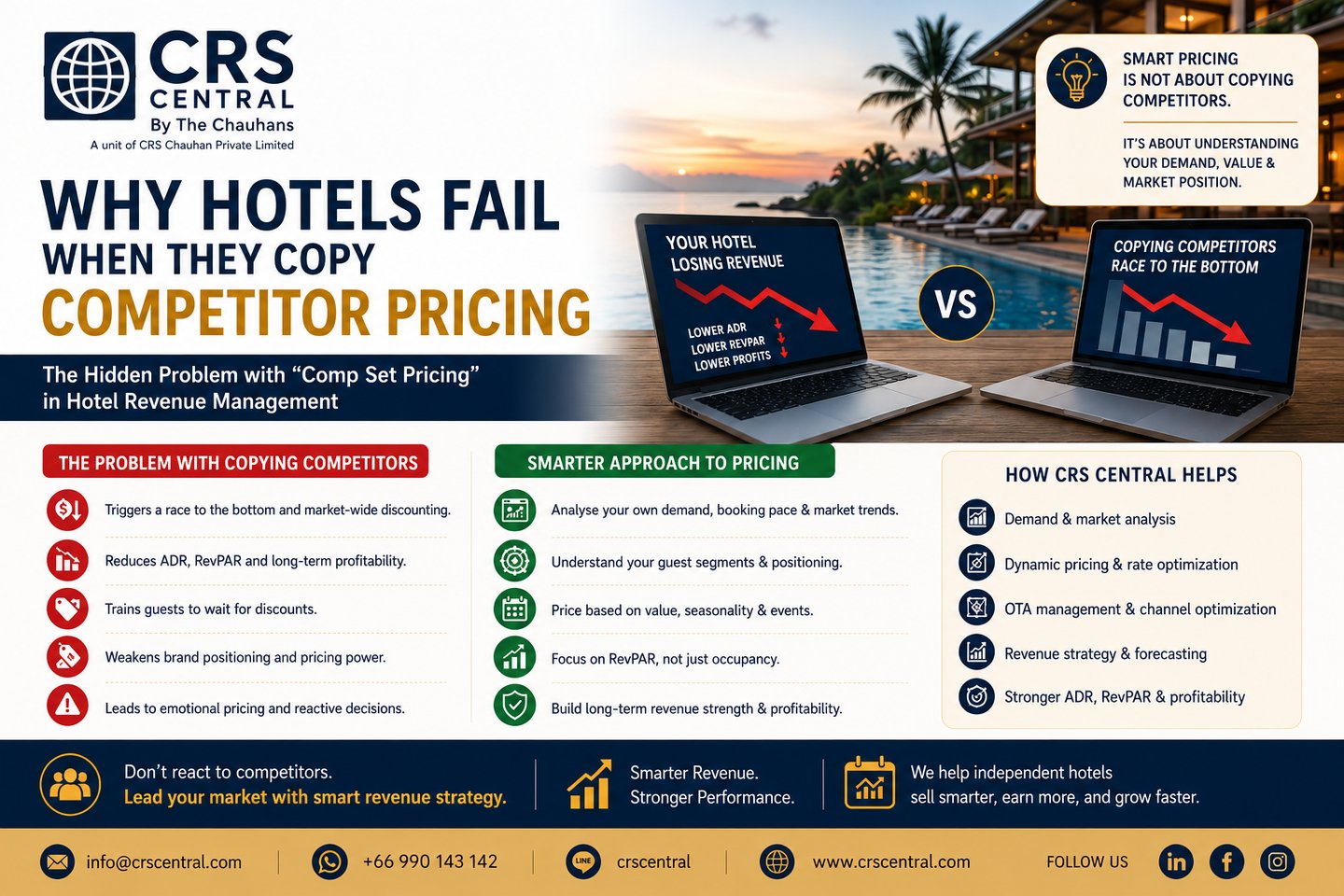
Why Hotels Fail When They Copy Competitor Pricing
The Hidden Problem with “Comp Set Pricing” in Hotel Revenue Management
5/17/20263 min read
Why Hotels Fail When They Copy Competitor Pricing
The Hidden Problem with “Comp Set Pricing” in Hotel Revenue Management
Many independent hotels believe competitor pricing is the safest way to decide room rates.
A nearby hotel drops price — so they drop too.
A competitor launches promotions — they follow immediately.
Another property increases occupancy — panic pricing begins.
At first, this feels logical.
But over time, this approach quietly damages profitability, weakens pricing confidence, and creates unnecessary market-wide discounting.
The reality is simple:
👉 Successful revenue management is not about copying competitors.
👉 It is about understanding your own demand, positioning, and value.
At CRS Central, we often see hotels relying too heavily on “comp set pricing” without understanding whether those competitor rates actually make sense for their own property.
This is one of the biggest hidden revenue mistakes in hospitality today.
What Is Comp Set Pricing?
In hotel revenue management, a “comp set” refers to a group of competitor hotels that are monitored for pricing and market positioning.
Hotels often compare:
Room rates
Occupancy levels
Promotions
OTA visibility
Guest reviews
Packages and offers
Monitoring competitors is important.
But the problem begins when hotels start copying competitor prices without understanding the reason behind them.
Why Copying Competitor Rates Is Dangerous
Every hotel operates differently.
Even hotels located on the same street may have completely different:
Cost structures
Guest segments
Booking patterns
Reputation scores
Direct booking strength
OTA dependency
Operational goals
When hotels blindly match competitor rates, they often ignore their own business reality.
A competitor may lower prices because:
They have excess unsold inventory
Group business cancelled suddenly
Renovation impacted occupancy
Their reviews declined
They need short-term cash flow
They are following a completely different strategy
If another hotel copies those rates without context, they may reduce revenue unnecessarily.
The Race to the Bottom Problem
One hotel discounts.
Then another follows.
Then the entire market weakens.
This creates what revenue managers often call a “race to the bottom.”
In many destinations, especially growing hospitality markets, hotels unintentionally train guests to wait for discounts instead of booking confidently at normal rates.
Over time, this damages:
ADR (Average Daily Rate)
RevPAR (Revenue Per Available Room)
Brand positioning
Profit margins
Long-term pricing power
The hotel may still fill rooms — but profitability becomes weaker and harder to sustain.
Why Occupancy Alone Can Be Misleading
Many hotels focus heavily on occupancy percentage.
But occupancy without healthy pricing can become dangerous.
For example:
A hotel running at 85% occupancy with aggressive discounts may actually earn less profit than a hotel operating at 65% occupancy with stronger pricing discipline.
This is why experienced hotel owners and General Managers focus heavily on:
RevPAR
ADR
Net profitability
Channel mix
—not just occupancy alone.
What Smart Revenue Management Looks Like
Professional revenue management does monitor competitors — but it does not blindly follow them.
Instead, smart pricing decisions are based on:
Demand patterns
Booking pace
Remaining inventory
Seasonality
City-wide events
Lead time behaviour
Market segmentation
Historical performance
Competitor pricing is only one piece of the puzzle.
The real goal is understanding:
👉 What is the right price for your hotel today?
Why Independent Hotels Are Most Affected
Large hotel chains often have:
Dedicated revenue teams
Forecasting software
Historical market data
Pricing systems
Loyalty programs
Independent hotels usually rely more heavily on manual decisions and OTA pressure.
This makes them more vulnerable to emotional pricing reactions and competitor-driven discounting.
Unfortunately, many boutique and independent hotels end up undervaluing themselves despite offering excellent guest experiences.
How CRS Central Helps Hotels Price Smarter
At CRS Central, we help hotels move away from reactive pricing and toward structured revenue strategy.
We work as an extended revenue team, helping hotels:
Analyse demand trends
Monitor booking pace
Optimize OTA performance
Improve rate positioning
Reduce unnecessary discounting
Protect ADR and RevPAR
Build healthier long-term pricing discipline
Our focus is not simply increasing occupancy.
👉 Our focus is maximizing profitable revenue.
The Long-Term Advantage of Smarter Pricing
Hotels that stop blindly copying competitors often experience:
Stronger ADR
Better RevPAR
Healthier profit margins
Improved guest perception
Reduced OTA dependency
More stable long-term performance
Most importantly, they build confidence in their own market value.
Frequently Asked Questions
What is comp set pricing in hotels?
Comp set pricing is the process of monitoring competitor hotel rates and market positioning to guide pricing decisions.
Should hotels monitor competitors?
Yes. Competitor analysis is important, but rates should not be copied blindly without understanding market demand and business strategy.
Why is discounting dangerous for hotels?
Frequent discounting lowers ADR, weakens brand positioning, increases OTA dependency, and can reduce long-term profitability.
How does CRS Central help hotels improve pricing?
CRS Central supports hotels with revenue management, forecasting, OTA optimization, dynamic pricing, and strategic rate management to improve profitability and RevPAR.
Final Thought
Competitor pricing should guide awareness — not control your strategy.
Hotels that constantly react to competitors often lose pricing confidence, revenue potential, and long-term market strength.
The hotels that perform best are not always the cheapest.
👉 They are the hotels that understand their value and price strategically.
Let’s Build Smarter Revenue Strategy
If your hotel is relying too heavily on competitor pricing or discounting, it may be time for a structured revenue review.
📩 info@crscentral.com
📱 WhatsApp: +66 990 143 142
🌐 CRS Central
Contact
Get in touch with us
Phone
info@crscentral.com
+66 (0) 990 143 142
© 2025. All rights reserved.
CRS Central is a brand owned and operated by CRS Chauhan Private Limited.