Why Boutique & Independent Hotels Often Undersell Their True Value
And How Smarter Revenue Management Unlocks Stronger Profitability
REVENUE MANAGEMENT LEADERSHIP
5/3/20264 min read
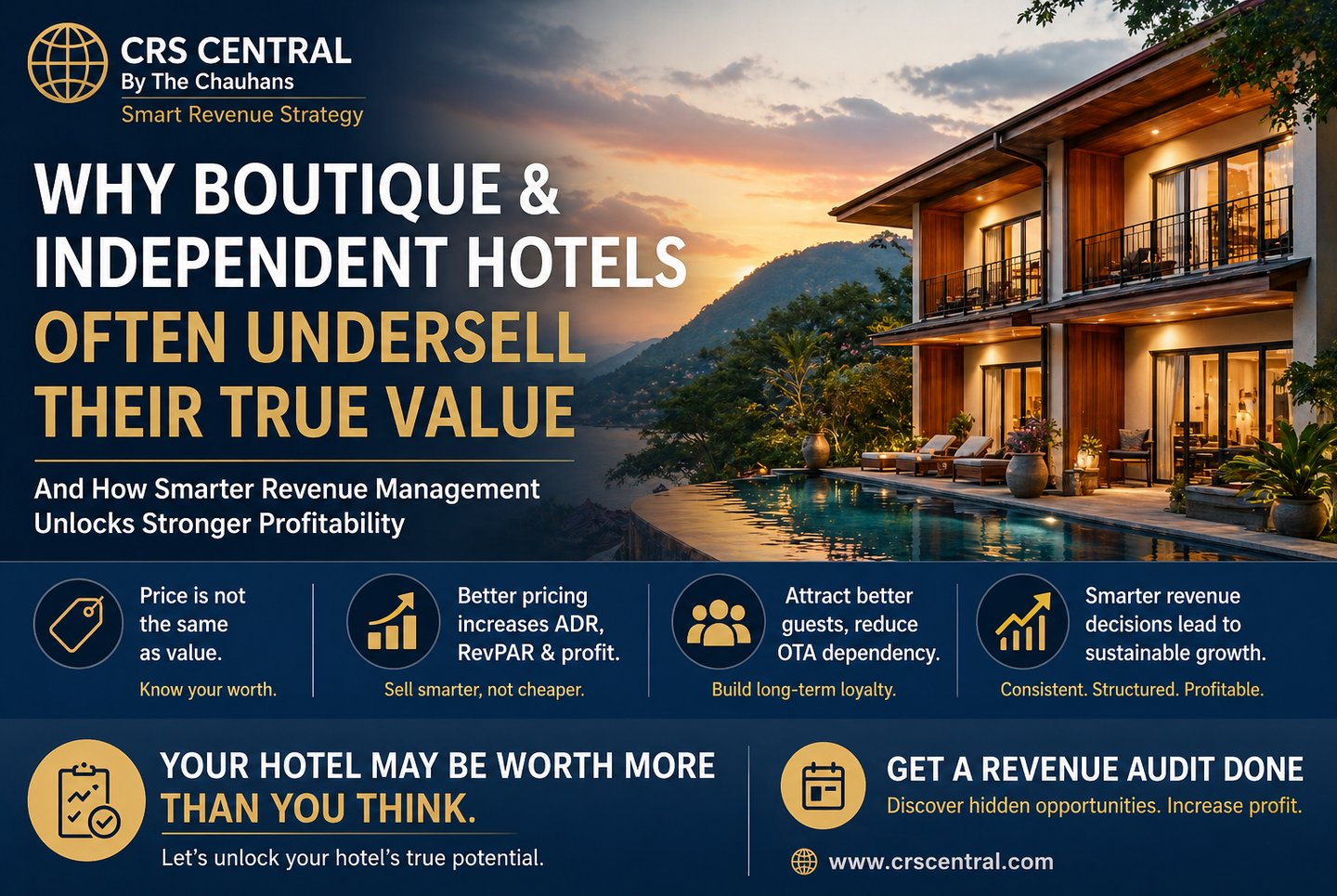
Boutique and independent hotels often offer something many large chain hotels struggle to replicate: personality, warmth, and a memorable guest experience. They may have unique architecture, thoughtful design, personalized service, or a deeper connection to the local culture. In many cases, guests leave these hotels with stronger memories than they do from staying at a standardized branded property.
Yet despite delivering a quality experience, many boutique and independent hotels still face one common challenge:
👉 They often sell themselves too cheaply.
This usually does not happen because the hotel lacks value. It happens because the hotel lacks a structured pricing strategy.
The Hidden Gap Between Product Quality and Revenue Performance
Many independent hotels invest significantly in their property. Owners spend money improving rooms, upgrading bathrooms, enhancing guest service, refining breakfast offerings, or creating beautiful public spaces. They care deeply about hospitality and guest satisfaction.
However, while product quality improves, pricing strategy often remains reactive.
Rates may be adjusted based on what a nearby competitor is charging. Discounts may be launched quickly when bookings feel slow. Promotions may be accepted from OTAs without fully understanding the long-term impact.
As a result, a hotel with strong guest appeal may still underperform financially.
Why This Happens More Often in Independent Hotels
Large hotel chains often have centralized revenue teams, pricing systems, brand data, and forecasting tools. Independent hotels usually do not have these resources internally.
That means pricing decisions are often handled by already busy owners, general managers, or front office teams who are also managing daily operations. Understandably, revenue strategy becomes reactive rather than proactive.
For example, if bookings slow for a few days, rates may be reduced immediately. If a competitor drops price, the reaction may be to match it. If an OTA suggests a promotion, it may be accepted quickly to generate short-term occupancy.
These decisions can feel practical in the moment—but repeated over time, they reduce profitability.
Price Is Not the Same as Value
One of the biggest misunderstandings in hospitality is assuming that guests only choose the cheapest option.
In reality, many travelers make decisions based on a combination of factors. They look at reviews, cleanliness, location, photos, atmosphere, design, trust, convenience, and the feeling the hotel creates.
A boutique hotel with strong ratings and a distinctive experience often has pricing power that owners underestimate.
Guests are often willing to pay more for charm, comfort, authenticity, and service consistency. But if the hotel constantly underprices itself, it sends the wrong message to the market and leaves money on the table.
The Long-Term Cost of Discounting Too Much
Discounting can sometimes be useful when applied strategically. But when used too frequently, it creates problems.
First, it lowers ADR (Average Daily Rate), which directly impacts room revenue. Second, it often attracts highly price-sensitive guests who are less loyal and more likely to compare every rate. Third, it increases dependence on OTA channels, where commissions further reduce profit.
Over time, the market begins to associate the hotel with lower pricing rather than higher value. Once that happens, increasing rates later becomes more difficult.
The hotel may appear busy—but profitability remains weak.
Why Bigger Chains Often Outperform Smaller Hotels
Large chains do not always outperform because they offer a better guest experience. Often, they outperform because they have stronger systems.
They understand demand patterns. They manage pricing daily. They know when to hold rates and when to stimulate demand. They use loyalty programs and direct channels effectively. They maintain consistency across distribution.
Independent hotels can absolutely compete with chains—but they need structured revenue discipline to do it.
What Smarter Revenue Management Looks Like
Revenue management does not need to be complicated. At its core, it means making better pricing and inventory decisions using real data instead of emotion.
It starts with dynamic pricing—adjusting rates based on demand, seasonality, booking pace, and remaining inventory. It includes understanding which channels bring the best net revenue, not just the most bookings.
It also means protecting rate parity across OTAs and direct channels, monitoring how quickly rooms are selling, and recognizing when the hotel has room to charge more confidently.
For boutique hotels especially, revenue management should support the brand’s value—not undermine it.
Why This Matters in Growing Hospitality Markets
In many developing and fast-growing destinations, independent hotels often compete aggressively on price. This can create a race to the bottom where everyone fills rooms but few maximize profit.
Hotels that implement smarter pricing earlier often gain a long-term advantage. They establish stronger market positioning, healthier ADR, and better guest perception.
Instead of teaching the market to expect discounts, they teach the market to recognize value.
How Better Pricing Improves Performance
When boutique and independent hotels stop underselling themselves, the results can be significant.
ADR improves because rooms are sold closer to their true value. RevPAR grows because pricing and occupancy become more balanced. Direct bookings increase when trust and consistency improve. Guest quality often improves as the hotel attracts travelers who value experience rather than only price.
Most importantly, profitability becomes healthier and more sustainable.
Sometimes hotels do not need more bookings. They need better bookings at better rates.
How CRS Central Helps Independent Hotels
At CRS Central, we specialize in helping boutique and independent hotels unlock hidden revenue potential.
We work as an extended revenue team, providing structured support without the cost of building a full in-house department. Our role includes pricing strategy, forecasting, OTA optimization, rate parity management, booking pace analysis, and identifying revenue leakage.
Because our team comes from hotel operations backgrounds, we focus on practical decisions that work in the real world—not just theory.
Why Hotels Choose CRS Central
Hotels choose CRS Central because they want expert revenue management with flexibility and hands-on execution.
We understand the realities of independent hotels: lean teams, operational pressure, owner involvement, and the need for quick decisions. Our support is designed to strengthen results while fitting naturally into hotel operations.
Many boutique and independent hotels are not underperforming because their product is weak.
They are underperforming because their pricing is weaker than their product deserves.
Your hotel may be worth more than you think. The market may be willing to pay more than you assume. The key is building the confidence and strategy to price accordingly.
Let’s Unlock Your Hotel’s True Value
If your hotel offers quality but profitability feels below potential, it may be time for a structured revenue review.
📩 Get a Revenue Audit Done
🌐 https://crscentral.com
Contact
Get in touch with us
Phone
info@crscentral.com
+66 (0) 990 143 142
© 2025. All rights reserved.
CRS Central is a brand owned and operated by CRS Chauhan Private Limited.