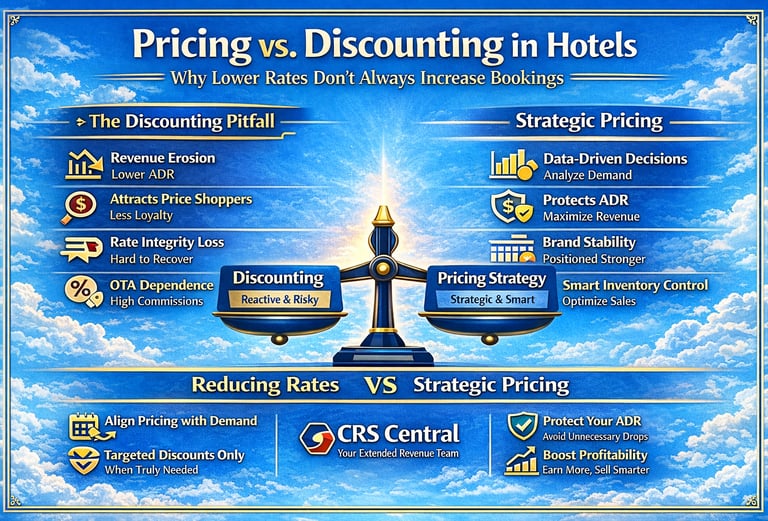
Pricing vs Discounting in Hotels — Why Lower Rates Don’t Always Increase Bookings
REVENUE MANAGEMENT LEADERSHIP
4/5/20263 min read
In competitive hotel markets, one of the most common reactions to slow bookings is simple:
👉 Reduce the price. But think about it, is it really the solution?
At first glance, this feels logical.
Lower price → More demand → Higher occupancy.
But in reality, pricing in hospitality doesn’t always work this way.
In many cases, excessive discounting does not increase revenue — it reduces it. At time you can do more GOP at 60% then at 80%. So you have to decide, you want more bottom line or are you just chasing the top line.
What Is Discounting in Hotel Pricing?
Discounting refers to reducing room rates below their optimal selling price in an attempt to stimulate demand.
This is often done:
During low occupancy periods
When competitors reduce rates
Closer to check-in dates
To achieve short-term occupancy targets
While discounting can generate bookings, it is often used without understanding actual demand.
What Is Strategic Pricing?
Strategic pricing is based on data, demand patterns, and booking behaviour — not just market pressure.
It considers:
Booking pace (pickup trends)
Demand forecasts
Remaining inventory
Seasonality and events
Lead time patterns
👉 The goal is not just to sell rooms —
👉 It is to maximize the value of each room sold
The Problem with Over-Discounting
When hotels rely too heavily on discounts, several issues arise:
1. Revenue Erosion
Lower rates reduce overall ADR, even if occupancy increases.
2. Attracting Price-Sensitive Segments
Discounting often brings guests who are less loyal and more price-driven.
3. Market-Wide Price Pressure
One hotel discounts → Others follow → Entire market weakens.
4. Loss of Rate Integrity
Frequent discounts make it difficult to increase prices later.
5. OTA Dependency Increases
Discounted rates often perform better on OTAs, increasing commission costs.
Why Lower Prices Don’t Always Increase Bookings
Hotel demand is not driven by price alone.
Other factors influence booking decisions:
Location
Reviews & ratings
Brand perception
Amenities & experience
Booking convenience
If demand is already weak, reducing price may not significantly increase bookings.
👉 Instead, it reduces the revenue from the bookings you would have received anyway.
When Discounting Actually Makes Sense
Discounting is not wrong — but it must be controlled and strategic.
It can be effective when:
✔️ There is clear excess inventory close to arrival
✔️ Demand is proven to be price-sensitive
✔️ Used for specific segments or closed user groups
✔️ Combined with restrictions (length of stay, advance purchase)
👉 The key is precision, not reaction
Pricing vs Discounting: The Real Difference
Discounting is reactive
Pricing is strategic
One responds to pressure.
The other responds to data.
Hotels that rely on pricing strategy:
✔️ Protect ADR during high demand
✔️ Avoid unnecessary revenue loss
✔️ Maintain brand positioning
✔️ Achieve more stable long-term performance
Why Hotels Often Fall Into the Discounting Trap
Common reasons include:
Lack of demand visibility
Over-reliance on competitor pricing
Pressure to increase occupancy
Absence of structured revenue strategy
Without clear insights, discounting feels like the safest option.
How Strategic Pricing Improves Performance
When pricing is aligned with demand:
Rooms are not sold too cheaply during high demand
Discounts are applied only when necessary
Inventory is managed more effectively
Revenue per available room improves
👉 The result is stronger profitability — even without increasing occupancy.
How CRS Central Supports Smarter Pricing
At CRS Central, we focus on replacing reactive discounting with structured pricing strategy.
We work as an extended revenue team, helping hotels:
Analyse booking pace and demand trends
Identify when discounts are truly required
Protect ADR during high-demand periods
Reduce unnecessary price drops
Align pricing across all channels
Our approach is practical, data-driven, and built around real hotel operations.
A Practical Perspective
Many hotels believe discounts are driving their bookings.
But a deeper analysis often shows:
👉 Bookings would have come anyway
👉 Rates were reduced unnecessarily
👉 Revenue potential was lost
A structured review can highlight where pricing decisions can be improved — not by increasing complexity, but by improving clarity.
Discounting feels like action.
But not all action leads to results.
In hotel revenue management:
👉 It’s not about selling cheaper — it’s about selling smarter
Hotels that move from reactive discounting to strategic pricing:
✔️ Earn more from the same demand
✔️ Strengthen market positioning
✔️ Build sustainable revenue growth
At CRS Central, we help hotels bring discipline and confidence into pricing — turning uncertainty into structured revenue performance.
🌐 Visit: https://crscentral.com
📩 Let’s identify where your pricing strategy can improve and unlock stronger results.
Contact
Get in touch with us
Phone
info@crscentral.com
+66 (0) 990 143 142
© 2025. All rights reserved.
CRS Central is a brand owned and operated by CRS Chauhan Private Limited.