
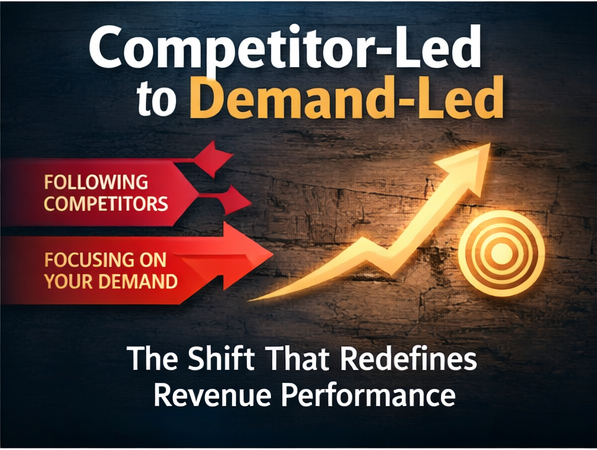
Competitor-Led to Demand-Led
The Shift That Redefines Revenue Performance
SMART REVENUE MANAGEMENT
3/8/20261 min read
Most hotels operate in a competitor-led framework without realizing it.
Daily rate checks drive pricing updates.
Competitive positioning determines discount depth.
Price matching becomes routine.
But competitor-led pricing is externally controlled.
Demand-led pricing is internally controlled.
What Demand-Led Really Means
Demand-led pricing focuses on measurable indicators such as:
Booking velocity vs same time last year
Pickup trends
Remaining inventory pressure
Lead time patterns
Segment performance
Market compression signals
If booking pace is accelerating, demand exists — regardless of competitor pricing.
If pickup slows meaningfully, rate strategy may need adjustment — independent of what others are doing.
Demand-led pricing shifts the focus from comparison to performance.
Why the Transition Feels Uncomfortable
Competitor-led pricing feels safer.
It distributes responsibility across the market.
Demand-led pricing requires:
Forecast confidence
Analytical discipline
Data literacy
Strategic patience
It means trusting your numbers even when competitors behave unpredictably.
But long-term revenue leaders are rarely the fastest reactors — they are the most disciplined analysts.
Recalibrating Strategy
Transitioning from competitor-led to demand-led often requires reassessing forecasting models, pickup analysis, and inventory controls. A detailed review of booking behavior and historical performance can clarify whether pricing is truly aligned with demand trends — or simply responding to external movement.
Contact
Get in touch with us
Phone
info@crscentral.com
+66 (0) 990 143 142
© 2025. All rights reserved.
CRS Central is a brand owned and operated by CRS Chauhan Private Limited.